

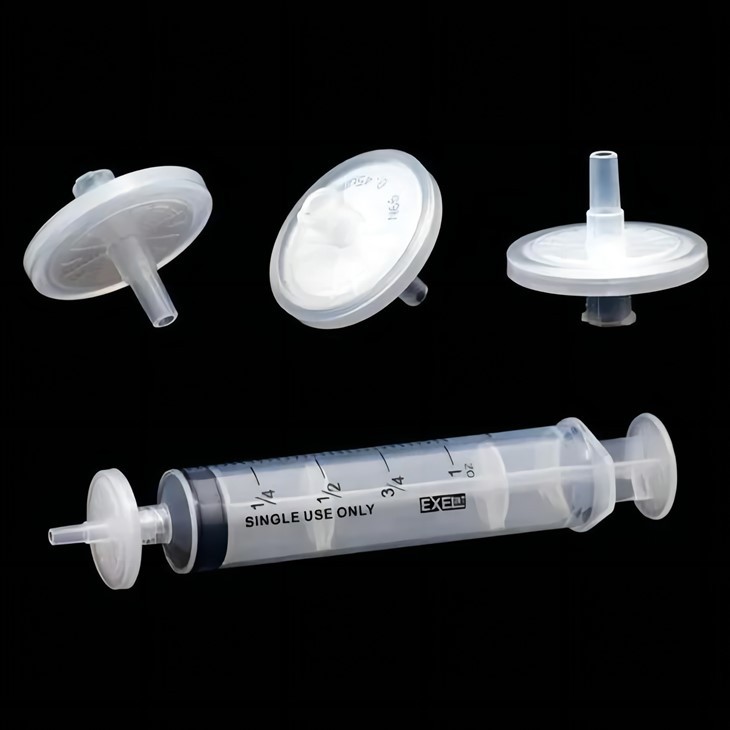
Key Technical Specifications
| Parameter | Specification |
|---|---|
| Membrane Material | Hydrophilic Polyethersulfone (PES) |
| Pore Size Options | 0.1 μm / 0.22 μm / 0.45 μm / 1.0 μm |
| Diameter Options | 13 mm / 25 mm / 33 mm / 50 mm |
| Housing Material | Medical-grade Polypropylene (PP) |
| Operating Pressure | Up to 6 bar (87 psi) |
| Temperature Resistance | 5°C – 90°C |
| Filtration Area | Optimized for fast aqueous flow |
| Extractables Level | Low extractables, suitable for sensitive biological analysis |
Why PES Membrane for Aqueous Solutions?
✔ Hydrophilic Nature
Unlike PTFE membranes, PES is naturally hydrophilic, meaning it does not require alcohol pre-wetting. This reduces sample preparation steps and avoids contamination risks.
✔ Ultra-Low Protein Binding
PES has extremely low adsorption to proteins and biomolecules, making it ideal for:
Enzymes
Antibodies
Cell culture media
Biological buffers
✔ High Flow Rate Efficiency
The asymmetric pore structure allows:
Faster filtration speed
Lower back pressure
Reduced clogging risk

FAQ:
1: Why is PES better than PTFE for aqueous solutions?
PES is naturally hydrophilic, while PTFE is hydrophobic and requires pre-wetting. PES provides faster and simpler filtration for water-based samples.
2: Can PES syringe filters be used for proteins?
Yes. PES has very low protein binding, making it ideal for biological and protein-based samples.
3: Is PES suitable for organic solvents?
No. PES is mainly designed for aqueous solutions. For organic solvents, PTFE or PVDF membranes are recommended.
4: What pore size is best for HPLC sample preparation?
0.22 μm is recommended for fine particle removal and column protection, while 0.45 μm is commonly used for routine analysis.
Hot Tags: pes syringe filter for aqueous solutions, China pes syringe filter for aqueous solutions manufacturers, suppliers, factory