

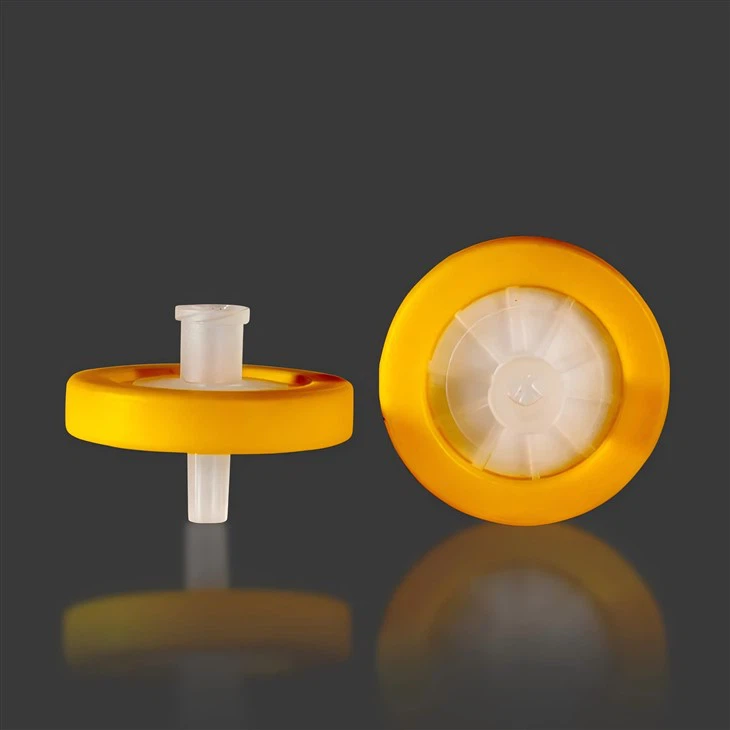
This filter employs a surface-retention microporous filtration mechanism. Liquid passes through a 0.1 μm PES membrane under pressure (typically generated by a syringe at 0.5–6 bar). The pore structure is a three-dimensional porous network with an irregular distribution, which can physically sieve and retain particles, bacteria, and colloidal substances with a diameter ≥0.1 μm. The PES membrane is a hydrophilic material and can directly filter aqueous systems without pre-wetting.
Key Technical Specifications
| Parameter | Specification |
|---|---|
| Membrane Material | Hydrophilic Polyethersulfone (PES) |
| Pore Size Options | 0.1 μm / 0.22 μm / 0.45 μm / 1.0 μm |
| Diameter Options | 13 mm / 25 mm / 33 mm / 50 mm |
| Housing Material | Medical-grade Polypropylene (PP) |
| Operating Pressure | Up to 6 bar (87 psi) |
| Temperature Resistance | 5°C – 90°C |
| Filtration Area | Optimized for fast aqueous flow |
| Extractables Level | Low extractables, suitable for sensitive biological analysis |
Material Characteristics
The filter membrane is made of polyethersulfone (PES) polymer material, with the following characteristics:
Hydrophilic structure: can be used directly in aqueous solutions and buffer solutions
Low protein adsorption surface: suitable for filtering protein or enzyme solutions
pH tolerance range is approximately 2–13 (depending on the solution system)
Tolerance to short-term operating temperatures up to approximately 90°C
The membrane structure is an asymmetric porous design, with an upper dense layer for retention and a lower support layer to improve flow rate stability.
Usage Instructions
The standard usage procedure is as follows:
Connect the syringe to the Luer interface.
Draw up the liquid to be filtered (typically 5–50 mL).
Apply pressure by manually pushing the piston.
The liquid is filtered through a 0.1 μm PES membrane.
Collect the filtrate for subsequent experiments or detection.
The filtration direction is typically "liquid inlet → PES membrane retention → outlet collection".
Typical Applications
The 0.1 μm PES syringe filter is primarily used for liquid pretreatment steps requiring the removal of bacteria or ultrafine particles:
Aseptic Laboratory Operations: Terminal filtration of culture media before cell culture to remove microorganisms ≥0.1 μm.
HPLC/LC-MS Sample Pretreatment: Filtering buffer or aqueous mobile phase to reduce system clogging.
Biopharmaceutical Solution Processing: Filtration of protein solutions before clarification to remove aggregates.
Molecular Biology Experiments: Sterilization filtration of enzyme solutions and PCR buffers.
Environmental Testing Samples: Particulate retention in water samples to improve detection stability.

FAQ:
1. What is a 0.1 μm PES syringe filter used for?
It is used for sterile-level filtration or ultrafine particle removal from liquids. Examples include filtering culture media before cell culture (removing microorganisms ≥0.1 μm), HPLC mobile phase filtration (removing particulate matter to prevent column clogging), and clarification of protein solutions (removing aggregates). Its core function is to retain bacteria and colloidal particles through the physical sieving structure of the 0.1 μm PES membrane.
2. What substances can a 0.1 μm pore size of the PES membrane filter out?
A 0.1 μm pore size PES membrane can retain particles with a diameter ≥0.1 μm, including common bacteria (such as E. coli, approximately 0.5–2 μm), some yeast cells, and suspended particulate matter. Since viruses are typically smaller than 0.1 μm, this filter cannot be used for virus-level retention; it is only suitable for bacterial filtration and particle removal.
3. Does a PES syringe filter require pre-wetting?
PES membranes are hydrophilic polyethersulfone materials that can be used directly in aqueous systems without the need for pre-wetting with methanol or ethanol. They can be directly filtered into buffer solutions, pure water, or culture media. However, in systems with high surface tension or containing small amounts of organic solvents, it may be necessary to monitor flow rate changes.
Hot Tags: 0.1 PES Syringe Filter, China 0.1 PES Syringe Filter manufacturers, suppliers, factory