

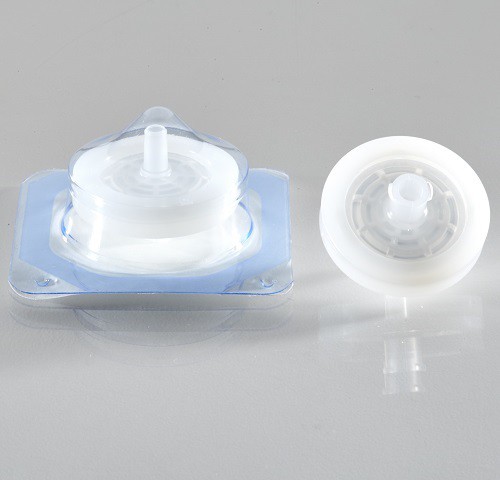
The operating principle is membrane-based surface and depth filtration.
When sample solution is pushed through the syringe filter:
Suspended particles larger than membrane pore size are retained on or within the membrane structure.
Liquid phase passes through interconnected pores in the PES membrane.
For 0.22 μm membranes, bacterial retention can be achieved for sterilizing-grade filtration under validated conditions.
For 0.45 μm membranes, particulate removal is typically the primary objective in HPLC and general laboratory sample preparation.
PES membranes generally use an asymmetric pore structure, where upstream pores are more open and downstream pores become tighter. This geometry increases dirt-holding capacity and reduces premature clogging.
Filtration performance is affected by:
Sample viscosity
Particle loading
Membrane surface area
Applied pressure
Chemical compatibility between membrane and sample matrix
Typical operating pressure is manual syringe pressure or low-pressure laboratory filtration, generally below 6 bar.
Housing
Material:
Medical-grade polypropylene (PP)
Function:
Supports membrane disc
Maintains pressure resistance
Provides chemical resistance to aqueous buffers and mild solvents
Typical construction includes:
Inlet luer lock connector
Membrane support layer
Welded upper and lower housing shell
Outlet luer nozzle
Some designs incorporate internal support ribs to prevent membrane rupture under pressure.
Operating Conditions and Use Environments
Laboratory PES Syringe Filters are used in aqueous or biological liquid filtration where low extractables and minimal analyte adsorption are required.
Typical conditions include:
HPLC / UHPLC Sample Preparation
Used before instrument injection for:
Removal of suspended particles
Protection of injector valves and columns
Reduction of baseline noise caused by contamination
Typical samples:
Mobile phases
Standard solutions
Aqueous analytical samples

FAQ:
When should a 13 mm syringe filter be used instead of a 25 mm filter?
A: Selection depends mainly on sample volume and particulate load.
13 mm filters are typically used for:
Sample volumes below 10 mL
Low particulate analytical samples
HPLC vial preparation
Limited-volume biological samples
25 mm filters are generally used for:
10–100 mL sample volumes
Higher suspended solids content
Reduced clogging risk through larger effective filtration area
Larger membrane area reduces flux per unit area, which can extend filter service capacity before blockage.
Hot Tags: laboratory pes syringe filter, China laboratory pes syringe filter manufacturers, suppliers, factory