

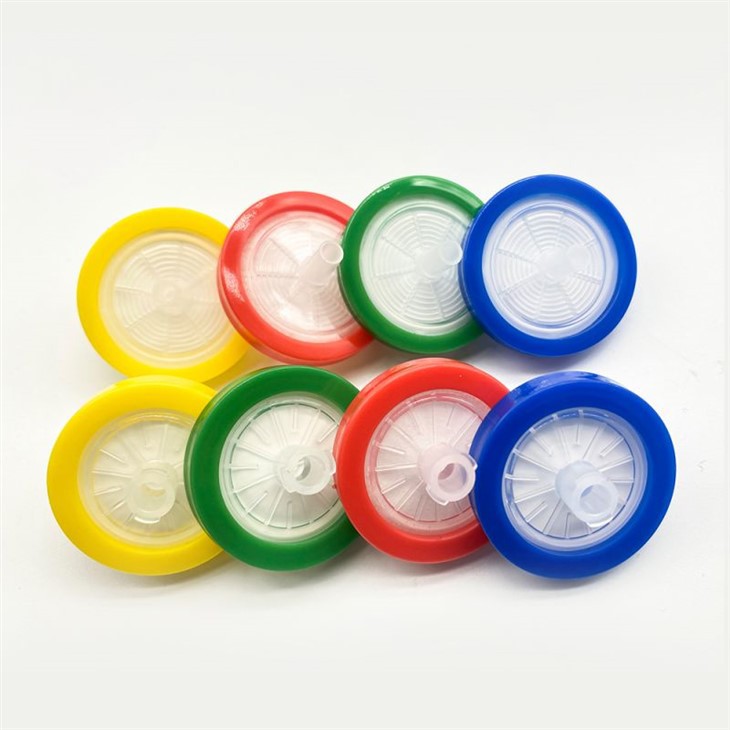
| Parameter | Typical Options |
|---|---|
| Membrane Type | Hydrophobic PTFE / Hydrophilic PTFE |
| Pore Size | 0.1 μm / 0.22 μm / 0.45 μm |
| Diameter | 13 mm / 25 mm / 33 mm / 50 mm |
| Housing Material | Polypropylene (PP) |
| Sterility | Gamma or EO sterilized |
| Pressure Rating | Up to 6 bar |
What Engineering Problems It Solves
Standard aqueous syringe filters often degrade, swell, or extract contaminants when exposed to aggressive solvents.
PTFE sterile syringe filters address filtration of:
Acetonitrile
Methanol
Acetone
Tetrahydrofuran (THF)
Toluene
Chlorinated solvents
Engineering problem solved:
Prevent membrane chemical attack
Maintain pore stability under solvent exposure
Reduce extractables entering analytical systems
Common use:
HPLC/GC sample preparation where solvent resistance is required.
Sterile Filtration Under Chemically Aggressive Conditions
Many sterile membrane systems lose integrity in mixed solvent systems.
PTFE allows:
Sterile filtration with solvent compatibility
Bacterial retention (0.22 μm sterile grade)
Filtration where cellulose or PES membranes may fail
Used in:
Pharmaceutical analytical labs
Chemical process R&D
Solvent-based formulation preparation

Structural Difference vs Traditional Filtration Solutions
| Feature | PTFE Syringe Filter | Standard Nylon / CA Filter |
|---|---|---|
| Solvent Resistance | High | Limited |
| Hydrophobic Venting Use | Yes | No |
| Chemical Inertness | High | Moderate |
| Protein Applications | Limited | Depends |
| Organic Sample Use | Preferred | Often unsuitable |
FAQ:
When should hydrophobic PTFE be selected instead of hydrophilic PTFE?
Selection depends on the process medium.
Hydrophobic PTFE is generally used for:
Air and gas sterilizing vent filtration
Organic solvent filtration
Moisture barrier venting
Fermentation vessel vent protection
Hydrophilic PTFE is selected when:
Filtering aqueous samples
Sterile filtration of water-based solutions
Mixed water/solvent systems require PTFE chemistry
Selection is governed by fluid wetting behavior and chemical compatibility, not only pore size.
Why is PTFE preferred over PES or nylon for solvent filtration?
The selection is usually driven by solvent resistance and membrane stability.
PTFE offers:
Resistance to aggressive organic solvents
Low extractables in solvent-rich matrices
Minimal swelling under solvent exposure
Stable pore geometry during chemical contact
In analytical solvent systems, this reduces risks of:
Membrane degradation
Contaminant leaching
Sample composition alteration
Hot Tags: ptfe syringe filter sterile, China ptfe syringe filter sterile manufacturers, suppliers, factory