

Table of contents
2. How do self-cleaning filters stay clean?
3. What components does an automatic self-cleaning filter consist of?
4. Advantages of self-cleaning filters
5. What types of self-cleaning water filters are there and how do they work?
6. Applications of self-cleaning water filters
7. What should you consider when buying a self-cleaning filter?
 In systems without proper filtration, pipes tend to accumulate sediment, affecting efficiency. Dirty water can cause scale buildup, equipment clogging, and pump performance degradation, leading to frequent and expensive maintenance. Self-cleaning water filters solve these problems by automatically cleaning according to user-set parameters.
Self-cleaning water filters are mainly available in five types: brush, nozzle, scraper, pneumatic disc, and automatic backwash. Let's take a closer look at their advantages and operational differences.
2. How do self-cleaning filters stay clean?
1. Innovative cleaning mechanism: Automatic Auto Clean Type Filter use unique and innovative mechanisms to effectively maintain their own cleanliness and ensure stable operation.
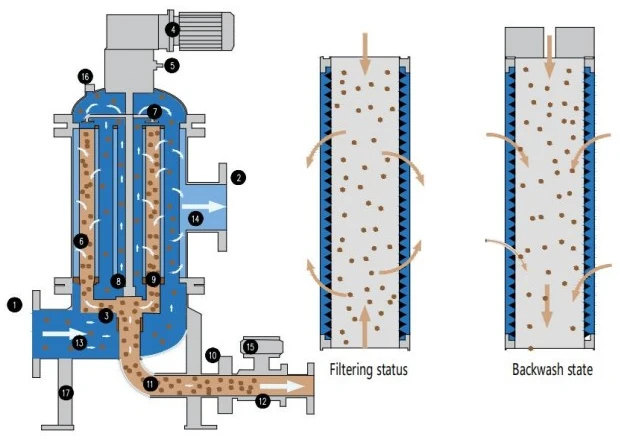
Multiple cleaning methods:
2. Backwashing technology: By allowing the water flow to flow in the opposite direction, the accumulated debris and impurities in the filter are washed away forcefully to restore the filtering performance.
3. Mechanically assisted cleaning: Some systems are equipped with mechanical scrapers or brushes that can physically scrape and brush off pollutants directly from the filter surface to ensure that the filter surface is clean.
4. Advantages of technical integration: Multiple cleaning technologies work together to continuously remove impurities, maintain the filter in the best working state, and extend its service life.
5. Intelligent integrated system: Automatic Self Cleaning Water Filters generally integrate intelligent sensors and control systems to automate the cleaning process. The sensor monitors key factors such as pressure difference and flow rate in real time, makes accurate judgments based on actual conditions, and triggers the cleaning cycle only when necessary.
6. Significant application advantages: Automated cleaning not only greatly improves work efficiency, but also reduces manual intervention. In important application scenarios that require uninterrupted operation, the advantages of automatic self-cleaning filters are prominent and are an ideal choice. At the same time, it can effectively save water and energy, which is in line with the concept of energy conservation and environmental protection.
3. What components does an automatic self-cleaning filter consist of?
1. Filter cleaning motor: Provides energy to propel the fluid and ensures the normal operation of the filter. When selecting, the filter size and application scenario must be taken into account to ensure sufficient energy and uninterrupted operation.
2. Inlet and outlet valves: The inlet valve allows the fluid to flow in during filtration. The size depends on the application scale. The appropriate inlet size can maintain the fluid flow under a certain pressure; the outlet valve allows the filtered fluid to flow out.
3. Control system: It is equivalent to the "brain" of the automatic self-cleaning filter, which can monitor parameters such as pressure difference, flow rate, and cleaning cycle time interval.
4. Drain plug, filter element and dirt collector: The drain plug is at the base of the filter to discharge pollutants to maintain operation; the filter element retains harmful particles. Due to the different quality of the filtered fluid, the size and material are different, and regular maintenance is required; the dirt collector collects pollutants generated during filtration to ensure that the application process continues until it needs to be cleaned to maintain maximum production capacity.
4. Advantages of self-cleaning filters
The versatility and automation of Auto Clean Strainerlay the foundation for making industrial processes more efficient, reliable, and cost-effective.
1. Low maintenance costs: One of the biggest advantages of Round Liquid Filter is their low maintenance costs. This makes them ideal for remote sites as they require no operator intervention.
2. Continuous cleaning: Industrial Auto Self Cleaning Filter are able to clean themselves while the system is running. This saves the user money, energy, and time.
3. Cost and energy savings: Self-Cleaning Automatic Filter have no blackouts for manual cleaning, helping to reduce downtime and increase productivity. This saves the usercosts and energy.
4. Compact design: Self-cleaning filters are often designed with compactness in mind to provide flexibility when installed in a variety of industrial environments.
5. What types of self-cleaning water filters are there and how do they work?
There are many types of self-cleaning filters, and their working mechanisms vary to remove debris and maintain filtration efficiency. Common types and principles are as follows:

1. Brush-type fully automatic self-cleaning filter: With a built-in rotating brush, particles are trapped and gradually deposited when water flows through the filter. The rotating brush starts at a fixed time to brush off the debris on the surface of the filter element and flush it out of the system. It is effective in removing larger particles and is often used in scenes that are prone to deposition.
2. Suction nozzle self-cleaning filter: When the system detects a drop in pressure (possibly clogged), the suction nozzle creates a vacuum to suck away the debris on the surface of the filter element and then flush it out of the system to ensure continuous filtration. This type of filter is suitable for handling medium-sized particles and is widely used in industrial environments.
For prices and details on brush-type automatic filters and suction nozzle self-cleaning filters, please contact us now!
1. Scraper-type self-cleaning filter: With a rotating scraper, water flows through the filter. After particles are deposited on the surface, the scraper regularly scrapes away debris and guides it to the discharge port. It can remove large and small particles and is widely used in water treatment plants and industrial processes.
2. Pneumatic disc filter: It uses air and water pressure for cleaning. The filter element is a stacked disc. When cleaning, the discs are separated, water and air are injected, and the pressure is released to flush away the debris. It is suitable for fine filtration scenarios such as wastewater treatment and irrigation systems.
3. Automatic backwash filter: When blocked, the water flow reverses to start backwashing, and automatically resumes normal filtration after flushing away the debris. It can be used in a variety of environments such as residential, commercial and industrial.
6. Applications of self-cleaning water filters
1. Self-Cleaning Automatic Filter: plays a key role in industrial environments, mainly used to remove suspended solids from water or other liquids. Commonly used in sewage treatment plants, it helps to purify sewage; in food and beverage processing, it ensures the purity of production water; it is also used in irrigation systems to prevent impurities from clogging the nozzles and affecting the irrigation effect.
2. Stainless Steel Liquid Filter: With a unique suction nozzle design, water quality maintenance is easy and efficient. Widely used in agricultural irrigation systems to prevent debris and particles in the water from clogging pipes; in wastewater treatment facilities, it filters out solid impurities to prevent pipes and pumps from being blocked and ensure a smooth treatment process.
3. Auto Self Cleaning Filter:It can effectively remove debris and reduce maintenance downtime. Suitable for scenes with high solid content, such as the mining industry, to handle water with a large amount of solid impurities; in industries such as oil and gas, chemical processing, etc., to deal with the problem of traditional filters that may be blocked by viscous liquids.
4. Automatic Self Cleaning Filter:uses advanced technology to provide excellent filtration performance. In municipal water treatment plants, it is used to remove fine particles and impurities from drinking water to ensure the safety of residents' water; in the pharmaceutical industry, it meets the demand for continuous flow of clean water to ensure that drug production meets quality standards.
5. auto clean strainer: With a multifunctional design, it performs well in various industrial applications. It is suitable for scenes with different degrees of pollution and requires frequent cleaning and maintenance. For example, in cooling tower systems, it filters circulating water to prevent scaling, corrosion and microbial growth, and maintain cooling efficiency.

7. What should you consider when buying a self-cleaning filter?
1. Type of pollutants: It is key to identify the type of pollutants in the fluid. Different sizes of pollutants need to match the corresponding filters. For example, a micro self-cleaning filter is required for a fluid containing micro pollutants; a large filter is required for a fluid with more pollutants.
2. Fluid characteristics and filter functions: The strain, temperature, pressure and filter workload of the fluid should be considered comprehensively. Only by mastering these can you choose a self-cleaning filter that is suitable for the application.
3. Labor and cost: The labor cost of installing and maintaining a self-cleaning filter cannot be ignored, especially for automatic cleaning models. At the same time, attention should be paid to the impact of downtime on the operation of the filter. Reducing downtime can ensure the best application performance.
4. Pollutant disposal: It is important to safely dispose of pollutants. Some chemicals can be handled directly, while some chemicals in industrial environments have environmental risks. Appropriate disposal methods need to be explored to balance cost and environmental protection.
5. Filtration efficiency: When choosing, you need to be clear about the required filtration level. Different filters have different efficiencies. The selected one must be able to effectively achieve the filtration purpose and ensure that the output fluid is clean and free of pollution.
6. Long-term reliability: This guide is designed to help you select a self-cleaning filter to ensure long-term reliable operation. Faced with numerous options, grasping the above key factors can simplify the decision-making process.
In the industrial field, efficient filtration is crucial to the stable operation and long life of industrial systems. It can not only ensure product quality, but also reduce equipment loss and maintenance costs, and improve production efficiency. Self-cleaning water filters have become an ideal choice for industrial systems due to their unique advantages. Different types have different advantages and are suitable for various industrial needs.
The brush-type automatic self-cleaning filter uses a rotating brush to regularly clean the filter element and efficiently remove large particles of impurities. In the papermaking industry, it can prevent nozzles and pipes from clogging and ensure the production process. The nozzle self-cleaning filter uses vacuum suction to accurately filter medium particles. It can also operate efficiently in a low-pressure environment. It is often used in agricultural irrigation to prevent nozzle clogging and improve water resource utilization. The scraper self-cleaning filter uses a rotating scraper to solve the problem of filtering high-concentration solid impurities and viscous liquids, ensuring smooth processes and reducing downtime in petroleum and chemical production. The pneumatic disc filter combines air and water pressure to remove impurities through the pressure difference generated by the instantaneous separation of the disc. It has high filtration accuracy and can provide ultra-pure water for electronic chip manufacturing. Automatic backwash filters use water flow to reversely flush, which is simple to operate, highly automated, and can adapt to different water qualities. In the building's central air conditioning cooling system, it keeps the circulating water clean and improves operating efficiency.
In short, different types of self-cleaning water filters have unique functions. Enterprises should choose the most suitable filter based on their own industrial system characteristics, fluid characteristics and filtration requirements to achieve efficient, stable operation and long life of the industrial syste