

Industrial filtration systems often handle aggressive chemicals, high-temperature fluids, and high-purity process media. In these environments, selecting a filter involves more than matching a micron rating. Material compatibility, filtration efficiency, pressure limits, flow requirements, and contamination control all influence long-term performance.
A PFA Filter is commonly considered for demanding applications where chemical resistance and material purity are important. However, its suitability depends on the complete filter construction, including the membrane, support layers, end caps, seals, and other wetted components. Understanding these factors helps engineering teams and industrial buyers select a filtration solution that matches actual operating conditions.
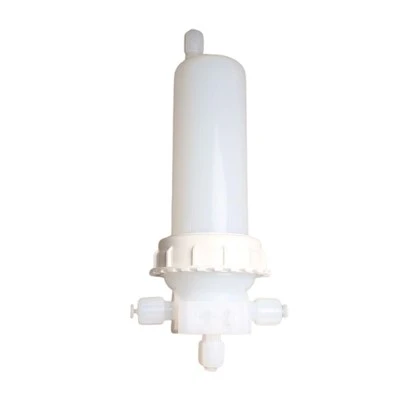
PFA Filter Construction and Material Composition
Filter construction determines how well a cartridge performs under chemical exposure, pressure changes, and continuous operation. PFA, or perfluoroalkoxy alkane, is a fluoropolymer valued for its chemical resistance, thermal stability, and low-contamination characteristics. It is frequently used in structural components that come into direct contact with process fluids.
When evaluating a PFA Filter, buyers should distinguish between the material used for the cartridge structure and the material responsible for particle retention. This distinction helps ensure that the selected configuration meets both chemical compatibility and filtration requirements.
- Filter membrane: The primary filtration layer. Depending on the cartridge design, materials such as expanded PTFE (ePTFE) may be used to provide the required particle retention characteristics.
- Support layers: These provide mechanical stability and help maintain the membrane structure under operating pressure.
- Inner core and outer cage: Structural components that support the cartridge and help resist deformation during operation.
- End caps and connectors: These determine the cartridge configuration and its compatibility with the filter housing.
- Sealing components: O-rings and gaskets help prevent bypass leakage. Their material compatibility must be checked separately.
One important distinction is that a filter with PFA structural components does not necessarily use PFA as its filtration membrane. For example, some designs combine a fluoropolymer housing or support structure with an ePTFE membrane. These materials serve different functions, so buyers should review the complete material specification rather than judging the product by its main material name alone.
Key Advantages of PFA Filtration Technology
Fluoropolymer-based filtration components are selected for applications where conventional materials may not provide sufficient chemical or thermal performance. Their advantages can support more stable filtration processes, particularly when the fluid composition and operating conditions are demanding.
Broad Chemical Resistance
PFA offers resistance to many aggressive chemicals, acids, and solvents. This makes it a potential choice for fluid systems where corrosion or material degradation could affect filtration reliability. Compatibility still needs to be confirmed against the specific chemical, concentration, temperature, and exposure time.
Thermal Stability
Fluoropolymer components can be suitable for elevated-temperature applications, depending on the material grade and cartridge construction. Buyers should consider the temperature limits of the entire assembly, since membranes, seals, adhesives, and connectors may have different operating ranges.
Low Contamination Potential
Suitable fluoropolymer materials used in a PFA Filter can help reduce unwanted interactions between filter components and process fluids. This is particularly relevant in high-purity manufacturing, where extractables, leachables, and particle shedding may affect downstream product quality.
Flexible Cartridge Design
Cartridge configurations can be designed around different flow rates, filtration requirements, connection types, and installation dimensions. Pleated membrane structures may provide a larger effective filtration area within a compact housing, although actual capacity depends on the media and cartridge design.
Major Industrial Applications
Fluoropolymer filtration, including PFA Filter applications, is used in industries where fluid purity, chemical compatibility, and process consistency are important. The specific cartridge configuration should be matched to the fluid characteristics and the requirements of each production stage.
Semiconductor and Electronics Manufacturing
Semiconductor production involves high-purity chemicals, specialty solvents, and process fluids that require controlled particle removal. Filtration components must be compatible with the fluid and suitable for the cleanliness requirements of the process. Material selection and contamination control are particularly important in these applications.
Chemical Processing
Chemical plants may process corrosive liquids, solvents, and specialty chemical mixtures. Filtration systems help remove unwanted particles before fluids enter reactors, transfer lines, or downstream equipment. Chemical compatibility should be assessed for every wetted component.
Pharmaceutical and Biotechnology Production
Pharmaceutical and biotechnology processes may require controlled filtration of process liquids, buffers, and specialty solutions. Filter selection should account for material compatibility, cleanliness, extractables, and validation requirements. Where sterile filtration is required, the selected membrane and cartridge must also have appropriate microbial retention validation. Chemical resistance alone does not establish sterilizing-grade performance.
High-Purity Water and Specialty Fluids
High-purity water systems and specialty liquid processes require filtration components that do not introduce unacceptable contamination. The appropriate cartridge depends on water quality, target particle levels, flow demand, and the cleanliness standard of the downstream process.
Filtration Ratings, Efficiency, and Flow Performance
Micron rating is one of the first specifications buyers review, but the rating alone does not fully describe filtration performance. It is important to understand how the manufacturer defines the rating and whether the stated efficiency is supported by an appropriate test method.
| Rating Type | Meaning | Buyer Consideration |
|---|---|---|
| Nominal Rating | Indicates a stated level of particle removal under a particular test or operating condition. The actual efficiency may vary. | Ask for the manufacturer's efficiency definition and supporting test data. |
| Absolute Rating | Generally refers to a more defined particle retention level, but the exact meaning depends on the stated test method and efficiency criteria. | Confirm the test standard, challenge particles, and required retention efficiency. |
Flow performance is another essential selection factor. A filter with a finer rating may create greater resistance to fluid movement, especially when the process contains suspended solids or has a high viscosity. A cartridge that is too small may reach its differential pressure limit quickly, resulting in more frequent replacement and increased operating costs.
- Required flow rate under normal and peak operating conditions.
- Initial pressure drop at the specified flow rate and fluid viscosity.
- Expected contaminant loading and dirt-holding capacity.
- Maximum allowable differential pressure during operation.
- Performance changes as the cartridge accumulates particles.
Chemical Compatibility and Operating Conditions
Chemical compatibility should be evaluated against the complete filter assembly, not just its primary polymer. Even when the main structural material has strong chemical resistance, other components may respond differently to the same fluid or operating environment.
-
Chemical identity: Identify the exact chemical or fluid mixture rather than relying on a general category.
- Concentration: Record the concentration or composition of the process fluid.
- Operating temperature: Consider both normal temperature and possible temperature fluctuations.
- Exposure duration: Continuous contact and short-term exposure may produce different material requirements.
- Wetted materials: Check the membrane, support layers, end caps, connectors, and sealing materials.
Pressure conditions also affect cartridge selection. Buyers should distinguish between operating pressure, maximum allowable pressure, and differential pressure across the filter element. These values describe different aspects of system performance and should not be treated as interchangeable.
Temperature and pressure limits should be checked together because the allowable operating range may change with temperature. The filter housing, cartridge structure, seals, and connections must all remain suitable for the intended conditions. For critical chemical processes, compatibility testing or documented confirmation from the manufacturer is advisable before large-scale procurement.
Installation, Wetting, and Maintenance Considerations
Correct installation is necessary to maintain filtration efficiency and prevent fluid bypass. Even a properly selected cartridge may fail to deliver the expected result if its dimensions, connection configuration, or sealing arrangement do not match the filter housing.
Installation Checklist
- Verify cartridge length, outer diameter, and end configuration.
- Confirm that the connection type matches the housing design.
- Inspect O-rings and sealing surfaces before installation.
- Follow the manufacturer's installation direction and tightening requirements.
- Check for leakage and abnormal pressure changes after startup.
Wetting Requirements
Membrane wetting behavior can influence startup performance. Hydrophobic ePTFE membranes, for example, may resist water penetration and require a suitable pre-wetting procedure when used with water-based fluids. The appropriate method depends on the membrane construction, process liquid, and application requirements. Buyers should not assume that every fluoropolymer cartridge uses the same wetting procedure.
Maintenance and Replacement
Maintenance intervals should be based on actual process conditions rather than a fixed replacement schedule alone. Monitoring differential pressure, flow rate, and downstream fluid quality can help identify changes in cartridge performance. A rising pressure drop may indicate contaminant loading, while an unexpected change in flow or filtrate quality may require further inspection. Replacement criteria should follow the filter manufacturer's recommendations and the operating limits of the system.
How to Select the Right Filter for Your Process
Selecting a suitable cartridge requires a clear understanding of the process fluid, filtration target, equipment configuration, and operating conditions. Procurement teams should prepare technical information before requesting quotations so manufacturers can evaluate the application and recommend an appropriate construction.
Technical Information to Prepare
- Fluid details: Chemical name, composition, concentration, viscosity, and particle characteristics.
- Filtration target: Required micron rating, particle retention efficiency, and downstream cleanliness requirements.
- Operating conditions: Normal flow rate, operating temperature, inlet pressure, and allowable differential pressure.
- Cartridge configuration: Required length, diameter, connection type, end-cap design, and sealing material.
- Compliance requirements: Material declarations, extractables information, integrity testing, and batch traceability where applicable.
Buyers should also evaluate the manufacturer's ability to maintain product consistency across repeated orders. This includes material control, dimensional inspection, filtration performance verification, and production records. For customized projects, technical communication during the design stage can help reduce compatibility issues and unnecessary changes after delivery.
A practical selection process should balance filtration performance with service life, operating cost, and maintenance requirements. The finest available micron rating is not automatically the best option. The right configuration is the one that meets the process target while maintaining suitable flow, pressure stability, chemical compatibility, and reliable operation.
Hanzhikang Custom Industrial Filtration Solutions and Manufacturing Service
Hanzhikang provides industrial filtration products and customized filtration solutions for equipment manufacturers, industrial users, distributors, and project procurement teams. With more than 15 years of industry experience, the company supports filtration projects involving different fluid characteristics, operating conditions, and equipment configurations.
For PFA-based filtration applications, customization can be evaluated according to the required filtration rating, cartridge dimensions, membrane material, structural components, connection configuration, and sealing requirements. Buyers can provide application details or technical drawings for product evaluation and specification confirmation. Each PFA Filter configuration can then be reviewed against the actual process conditions to ensure that the selected specifications meet the intended application requirements.
-
Incoming material inspection and production process checks.
- Dimensional and finished-product inspections.
- Customized product configurations based on application requirements.
- Quality records and corrective measures for production control.
Through OEM and ODM cooperation, Hanzhikang supports customers who require application-specific filtration components, consistent production specifications, and long-term supply coordination. Technical requirements can be reviewed before production to help align material selection, cartridge structure, and operating conditions with the intended filtration process.