

In semiconductor wet processing, electronics manufacturing, fine-chemical production, and other applications involving aggressive liquids, filter material selection affects chemical compatibility, fluid cleanliness, equipment life, and process stability. Buyers sourcing filtration assemblies in volume need to look beyond the polymer named in a product description. The housing, connections, seals, filter element, and manufacturing process must all suit the actual chemical and operating conditions.
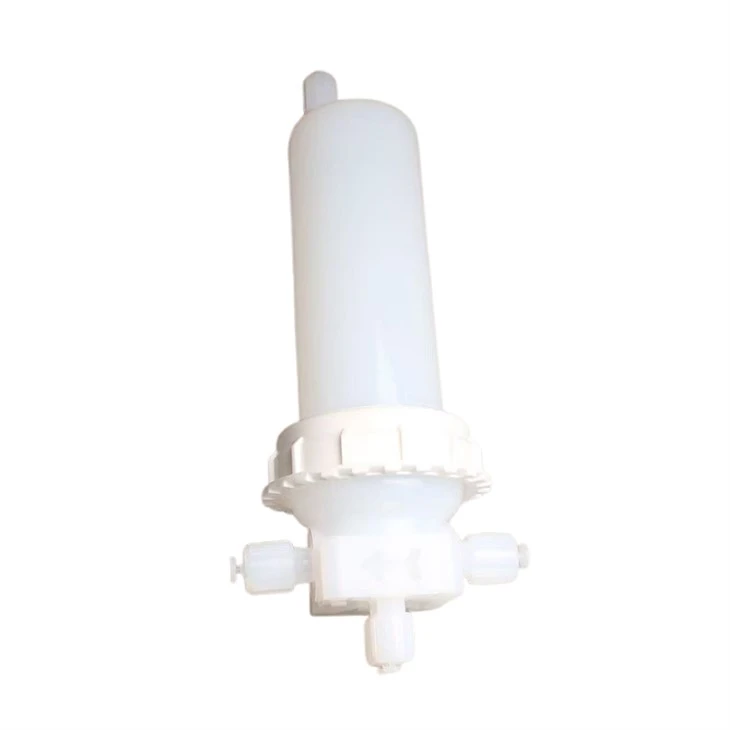
A PFA Filter is used where the chemical resistance and thermal performance of perfluoroalkoxy (PFA), a fluoropolymer, are important. However, PFA construction alone does not establish that an assembly is suitable for every chemical or high-purity process. Buyers should assess the complete wetted path and obtain model-specific technical data before approving a purchase.


Why Is a PFA Filter Used in Chemical-Resistant Applications?
PFA combines broad chemical resistance with the ability to be melt-processed. It can be molded into complex components and, with suitable processes, joined to form assemblies with fewer potential leak paths. Its smooth, low-adhesion surface can also support applications where residue retention and cleaning are concerns.
These properties make PFA relevant to systems handling many acids, bases, and high-purity process chemicals. Nevertheless, compatibility depends on the chemical, concentration, temperature, exposure time, mechanical stress, and any mixed-chemical conditions. Buyers should request a compatibility assessment for the actual process fluid rather than relying on a general statement such as "chemically resistant."
PFA should also be distinguished from the other materials in the assembly. A PFA housing does not mean that every component is made from PFA, nor does it identify the material of the filter membrane or media. The complete bill of materials should identify every wetted component.
Which Components Must Be Checked for Chemical Compatibility?
The housing is only one part of the wetted structure. Connecting nuts, plugs, seals, support components, and the filter element may use different polymers or elastomers. A mismatch in any one of these parts can lead to swelling, embrittlement, loss of sealing force, contamination, or leakage.
When specifying a PFA Filter, buyers should confirm the materials and limits of every wetted component:
Housing and base: Verify the PFA grade and the material of all parts exposed to the process liquid.
Connections and fittings: Check the polymer used for nuts, adapters, plugs, and ports, including its temperature and chemical limitations.
Seals: Confirm the elastomer type and its compatibility with the specific chemical. FKM and FFKM are not interchangeable; selection depends on the fluid, temperature, and service conditions.
Filter element: Identify the membrane or media material, support layers, effective filtration rating, and any extractables or cleanliness data required by the process.
Hanzhikang's published configuration identifies PFA for the barrel and base, PVDF for the connecting nut, and seal options that include FKM-based and optional FFKM arrangements. Buyers should confirm the exact component combination for the selected model and application.
How Should Temperature and Pressure Ratings Be Evaluated?
PFA has useful thermal performance, but the allowable operating pressure of a finished assembly is not determined by the polymer's temperature capability alone. Pressure resistance can change with temperature, component geometry, connection design, assembly method, and continuous exposure. Buyers should therefore review the pressure-temperature limits for the complete model rather than applying a material-level rating to the finished product.
Hanzhikang lists a reference operating temperature range of -40°C to +200°C and typical pressure resistance of 0.5–0.9 MPa, depending on the model. These figures should be treated as product references, not universal ratings for every configuration. Confirm the maximum working pressure at the intended operating temperature, pressure fluctuations, and whether the system will operate under positive pressure or vacuum.
PFA components can also deform under sustained mechanical load if design limits are exceeded. For installations involving tight fittings, elevated temperatures, or repeated pressure cycles, buyers should confirm the manufacturer's assembly instructions and service limits.
How Do Filtration Rating and PFA Construction Work Together?
PFA describes the material used in specified filter components; it does not, by itself, define filtration accuracy. Particle retention is determined by the filter element and its rated performance. Buyers should separately specify the required micron rating, particle characteristics, flow rate, allowable pressure drop, and process cleanliness target.
Hanzhikang's product information lists customizable filtration options from 0.05 μm to 10 μm. Buyers should confirm whether the stated rating is nominal or absolute, the test method used, and the compatible element material for the process fluid. A smaller micron rating is not automatically better: it may increase flow resistance or shorten service life if the process contains a high particle load.
For high-purity applications, ask for information relevant to the complete assembly, such as cleaning procedures, packaging controls, particle or extractables data where available, and traceability. Hanzhikang describes integrated welding intended to avoid metal contact with the process medium, together with ultrasonic cleaning and ultrapure-water treatment. The required cleanliness level and supporting documentation should be agreed before production.
What Should Buyers Verify Before Bulk Production?
A sample approval for a PFA Filter should establish more than appearance and dimensions. Before placing a volume order, purchasing and engineering teams should document the exact model, wetted-material list, filter-element specification, connection dimensions, operating limits, and inspection criteria.
A practical approval process includes:
- Reviewing drawings and confirming port sizes, connection standards, and installation dimensions.
- Checking the chemical compatibility of all wetted materials against the actual process conditions.
- Confirming the filtration rating, test method, and element construction.
- Agreeing on sealing and pressure-test methods, test conditions, and acceptance criteria.
- Approving a representative sample and requiring written approval for any later material or design changes.
Hanzhikang identifies sealing, pressure-resistance, and filtration-accuracy testing in its product quality-control process. Buyers should confirm the applicable test pressure, holding time, sampling frequency, and records supplied with each batch.
What Supply Details Matter for Repeat Orders?
For importers, distributors, and equipment integrators, consistent specifications across repeat orders are as important as the initial sample. Confirm the MOQ, production lead time, customization scope, material availability, packaging method, batch identification, and export documentation in writing. If private-label packaging or customized connections are required, provide artwork and drawings before production planning.
Hanzhikang gives a typical delivery reference of 2–3 weeks, subject to model, customization, and order quantity. This should be reconfirmed for each purchase. Packaging should protect connection surfaces and prevent dust or handling contamination, especially when the assembly is intended for a high-purity process.
Why Choose Hanzhikang for PFA Filter Procurement?
Hangzhou Hanzhikang Purification Equipment Co., Ltd. is a professional industrial filtration manufacturer with more than 15 years of industry experience. Operating a manufacturing facility exceeding 10,000 m², the company offers more than 500 product models and serves customers in over 50 countries. Its product range includes PFA filtration equipment, stainless steel filters, filter housings, bag filtration systems, self-cleaning filters, and customized filtration solutions. Automated production equipment, integrated welding processes, and an independent testing laboratory support its manufacturing and quality inspection capabilities.
Hanzhikang provides OEM/ODM services and customized filtration configurations for importers, distributors, semiconductor equipment suppliers, and industrial project buyers. Customization can be based on process conditions, material requirements, filtration ratings, and connection specifications. These options allow buyers to source a PFA Filter that matches their specific application requirements while maintaining consistent specifications for repeat orders.