

In the modern industrial production landscape, filters (filter machines) have become indispensable core equipment, playing a crucial role in solid-liquid separation, fluid purification, and product quality improvement. Utilizing physical filtration media to achieve efficient separation of solids and liquids, these versatile devices are widely used in chemical, pharmaceutical, light industry, food, mineral processing, coal, water treatment, and many other industries. With their diverse structures, small size, flexible operation, high efficiency, and closed working mode, filters have become the first choice for enterprises pursuing cost reduction, efficiency improvement, and quality upgrading.
The Working Principle of Filters: Simple Structure, Efficient Separation
The basic working principle of a filter is concise yet practical, relying on the separation effect of filtration media and the driving force of pressure difference to achieve solid-liquid separation. A simple filter is composed of a container divided into upper and lower chambers by a filtration medium-common media include screens, nets, paper, woven filter cloth, membranes, and more. During operation, the liquid to be filtered is injected into the filter through the inlet pipe. Under a certain pressure, solid impurities in the filtrate are retained by the filtration medium through mechanical filtration or adsorption filtration, while the pure liquid flows through the filtration medium, exits the filter through the outlet pipe of the lower chamber, and finally obtains the filtrate with impurities removed.
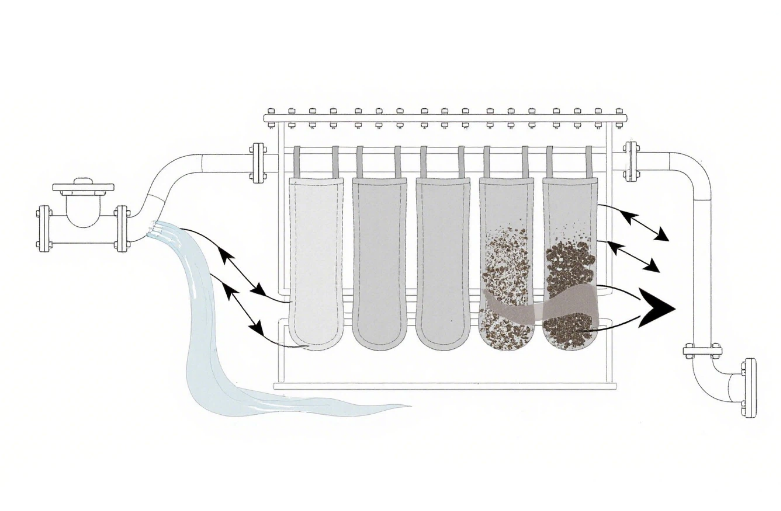
It is worth noting that the liquid must overcome resistance when passing through the filter residue layer and the filtration medium. Therefore, a pressure difference between the two sides of the filtration medium is an essential driving force for realizing filtration. By selecting filtration media with different pore sizes, enterprises can obtain filtrate that meets the required impurity content standards, adapting to different production process requirements. During the filtration process, the filter residue accumulated on the surface of the filtration medium gradually thickens to form a filter cake, which increases the resistance of the liquid passing through and reduces the filtration speed. When the filter chamber is filled with filter residue or the filtration speed is too slow to meet production needs, the filtration operation should be stopped in time to clean the filter residue or replace the filtration medium directly. In addition, according to the actual flow requirements of the production line, filters can be designed into single-bag/core or multi-bag/core structures to ensure stable and efficient operation of the entire production process.
Product Classification of Filters: Classified by Demand, Adapt to Diversified Scenarios
Filters have a variety of classification methods, which are mainly divided according to the way of obtaining filtration driving force, filtration objects, and filtration precision. Each type of filter has its own characteristics and applicable scenarios, allowing enterprises to make targeted choices based on their own production needs.
Classification by Filtration Driving Force
According to the different ways of obtaining filtration driving force, filters can be divided into three categories: gravity filters, vacuum filters, and pressure filters. Gravity filters rely on the gravity of the liquid itself to achieve filtration, with simple structure and low energy consumption, suitable for scenarios with low filtration requirements and small processing capacity; vacuum filters use negative pressure to form a pressure difference, which has high filtration efficiency and is widely used in mineral processing, chemical industry, and other industries; pressure filters use positive pressure to promote liquid filtration, with fast filtration speed and good separation effect, which is the most commonly used type in modern industrial production.
Classification by Filtration Objects
According to the different filtration objects, filters are divided into liquid filters and gas filters. Liquid filters are mainly used for the purification and filtration of various liquids (such as water, oil, chemicals, etc.), which is the focus of this article; gas filters are used for the filtration of industrial waste gas, compressed air, and other gases to remove solid impurities in the gas and protect subsequent equipment and environmental protection emission standards.
Classification by Filtration Precision
From low to high precision, filters can be divided into rough filtration, precision filtration, ultrafiltration equipment, and reverse osmosis equipment. Among them, rough filtration and precision filtration are the most widely used in industrial production, and we will focus on their characteristics and applications:
- Rough Filtration (Multi-Media Filtration)Rough filtration, also known as multi-media filtration, uses one or more filtration media. Under a certain pressure, turbid water with high turbidity passes through granular or non-granular materials of a certain thickness to effectively remove suspended impurities and clarify the water. Common filter media include quartz sand, anthracite, manganese sand, etc. Rough filtration is mainly used for water treatment turbidity removal, soft water, pre-treatment of pure water, and other links, and the turbidity of the effluent can reach below 3 degrees. However, its filtration precision is limited, so it is generally used as a pre-filter (front stage) to remove large-particle impurities first, protect subsequent high-precision filtration equipment, and extend the service life of the equipment.
- Precision Filtration (Security Filtration)Precision filters, also known as security filters, are favored by enterprises due to their compact structure, small floor space, simple installation and operation, and wide range of uses. The filtration precision ranges from 0.5 to 2500 μm, which is much thinner than human hair- the smaller the pore size, the higher the filtration precision of the filter. The cylinder shell is generally made of stainless steel (a small number of acid and alkali resistant PP materials are used), which has excellent high-temperature resistance and can work continuously in a high-temperature environment of 700℃, adapting to harsh industrial production conditions. The interior uses formed filter media, such as filter cloth, filter screen, filter bag, filter sheet, sintered filter tube, wound filter element, melt-blown filter element, metal filter element, etc. According to the different filter media, precision filters are mainly divided into three types: bag type, core type, and basket type.


- Bag Type Filter: The interior is supported by a metal mesh basket to hold the filter bag. The liquid flows in from the inlet, is filtered by the filter bag, and then flows out from the outlet. Impurities are intercepted in the filter bag. After replacing the filter bag or cleaning the filter residue (with a certain service life), it can be reused continuously. Its biggest advantages are large processing flow and small filtration resistance, which is suitable for scenarios with large liquid processing capacity, such as food and beverage, chemical industry, etc.
- Core Type Filter: Its structure is similar to that of the bag type filter, but it uses a filter element with higher filtration precision. The filtration precision is usually in the range of 0.001 to 100 μm. Common filter element materials include melt-blown PP filter elements, activated carbon filter elements, wound filter elements, folded microporous membrane cartridge filter elements, and high-temperature resistant functional metal filter elements (such as magnetic filter elements and titanium rod filter elements). Core type filters are suitable for scenarios with high requirements for filtration precision, such as pharmaceutical, electronic, and other industries.
- Basket Type Filter: Usually installed at the front end of the liquid delivery pipeline, its filtration precision is relatively low, and it is generally used as a front-stage filter. However, it has the advantages of simple and convenient cleaning and can be reused infinitely, which can effectively reduce the use cost of enterprises and is suitable for the pre-filtration of various industrial pipelines.
In actual application scenarios, many enterprises have achieved significant cost reduction and efficiency improvement through reasonable selection of filter types. For example, a chemical fertilizer plant uses a core type filter with magnetic filter elements to recover nickel-based catalysts from wastewater, achieving a 99.7% interception rate of particles above 0.5 μm, with an annual recovered catalyst value exceeding 2 million yuan, and the investment return period is shortened to 8 months. In the electronic industry, a 12-inch wafer factory uses EP-grade precision filters, reducing the particle defect rate in the lithography process from 12ppm to 2ppm and reducing the cost per wafer by 15%. These cases fully verify the important role of filter classification selection in industrial production.
Selection Principles of Filters: Scientific Selection to Ensure Stable Operation
Selecting a suitable filter is the key to ensuring filtration effect, reducing production costs, and extending equipment service life. Enterprises should follow the following five core principles when selecting filters, combining their own production process, medium characteristics, and operation requirements:
1. Inlet and Outlet Diameter Principle
In principle, the inlet and outlet diameter of the filter should not be smaller than the inlet diameter of the supporting pump, and generally, it should be consistent with the diameter of the inlet pipeline. This can avoid the reduction of liquid flow rate caused by the mismatch of diameters, ensure the smooth operation of the production line, and prevent the pressure loss from being too large, which affects the filtration efficiency.
2. Nominal Pressure Principle
The pressure level of the filter should be determined according to the maximum pressure that may occur in the filtration pipeline. If the nominal pressure of the filter is lower than the maximum pressure of the pipeline, it may cause equipment leakage, damage, and other safety hazards, affecting the normal production and even endangering the personal safety of operators. Therefore, it is necessary to fully consider the pressure fluctuation of the pipeline during selection to ensure that the filter can work stably under the maximum pressure.
3. Precision (Mesh Number) Principle
The filtration precision (mesh number) of the filter is mainly determined by the particle size of the impurities that need to be intercepted, which should be based on the requirements of the medium flow process. For example, in the pharmaceutical industry, the filtration precision requirement for pharmaceutical water and medical intermediates is extremely high, and a core type filter with high precision should be selected; in the water treatment pre-treatment link, a rough filtration filter with appropriate precision can meet the requirements, avoiding excessive precision leading to increased equipment investment and operating costs.
4. Filter Material Principle
The material of the filter is generally selected to be the same as the material of the connected process pipeline to ensure the consistency of the entire pipeline system and avoid corrosion and leakage caused by material mismatch. For different working conditions (such as acid-base environment, high-temperature environment, etc.), metal materials (cast iron, carbon steel, low alloy steel, stainless steel) or plastic materials (polypropylene, PVDF) can be considered. For example, in the acid-base chemical production process, acid and alkali resistant PP material or stainless steel material should be selected; in the high-temperature production scenario, stainless steel material with good high-temperature resistance is preferred.
5. Pressure Loss Calculation Principle
For water filters, under the general calculated rated flow rate, the pressure loss is 0.52 ~ 1.2kpa. When selecting the filter, the pressure loss should be fully considered to avoid the impact of excessive pressure loss on the operation of the entire production line. For scenarios with strict requirements on flow rate and pressure, it is necessary to carry out professional pressure loss calculation and select the filter with appropriate parameters.
In the context of increasingly fierce competition in the manufacturing industry going overseas, the scientific selection of filters is not only related to the stability of enterprise production but also an important part of reducing production costs and improving product competitiveness. For enterprises building Google independent stations, clearly displaying the selection principles and parameter standards of filters can help potential customers (such as industrial purchasers and engineers) quickly match their own needs, improve the conversion rate of inquiries.
Application Scope of Filters: Covering Multiple Industries, Creating Core Value
As a multi-purpose equipment with strong applicability, filters, especially precision filters, have been widely used in various industrial fields, becoming an important guarantee for improving product quality, protecting equipment, and ensuring environmental protection emission. Its specific application scope covers petroleum chemical industry, natural gas, coating, paint, ink, medicine, bioengineering, automobile manufacturing, electronics, electroplating, food, beverage, and many other fields, and its specific applications in each field are as follows:

Industrial Liquid Filtration

Pharmaceutical Manufacturing

Water Treatment

Chemical Processes
Petroleum Chemical and Natural Gas Industry
In the petroleum chemical industry, filters are used for the purification of hydrogen peroxide, resin, lubricating oil, polymer, viscose, aviation kerosene, and various oil products, as well as the separation and recovery of catalysts, chemical intermediates, and chemical products. In the natural gas industry, it is mainly used for CNG filtration of gas stations, filtration of amine liquid desulfurization and dehydrating agents, separation and purification of natural gas and refineries, and filtration of oilfield water injection, workover, and acidizing liquids, ensuring the safe and stable operation of the entire production and transportation process.
Coating, Paint, and Ink Industry
In the coating, paint, and ink industry, filters are used for the filtration of latex paint, paint raw materials and solvents, printing ink, printing ink, and additives. By removing impurities in raw materials and products, the fineness and uniformity of coatings, paints, and inks are improved, avoiding the occurrence of defects such as spots and impurities on the product surface, and improving the quality and appearance of products.
Medicine and Bioengineering Industry
In the medicine and bioengineering industry, the requirements for product purity and hygiene are extremely high. Filters are used for the filtration of infusion (LVP and SVP) pharmaceutical water, biological products such as plasma and serum, various pharmaceutical intermediates, pharmaceutical raw materials, and solvents, as well as CIP filtration and sterilization filtration of fermenter intake and exhaust gas. It effectively removes bacteria, impurities, and other harmful substances in the materials, ensuring the safety and effectiveness of pharmaceutical products and biological products.
Automobile Manufacturing Industry
In the automobile manufacturing industry, filters are used for the filtration of electrophoretic paint, topcoat, ultrafiltration water, pretreatment liquid, vehicle spray water, engine crankshaft manufacturing coolant, as well as the purification of industrial gas for painting and gas in the spray booth. By purifying various materials and gases, the quality of automobile painting is improved, the service life of engine and other core components is extended, and the overall quality and performance of automobiles are guaranteed.
Electronics and Electroplating Industry
In the electronics and electroplating industry, with the continuous development of microelectronics technology, the requirements for the purity of materials are getting higher and higher. Filters are used for the treatment of various chemicals in the manufacturing process of liquid crystal displays, lithography machines, optical discs, copper foil, integrated circuits, and other microelectronics and electronic products, as well as the purification of electroplating liquid, process gas, and gas in the clean room, avoiding the impact of impurities on the performance and service life of electronic products.
Food, Beverage, and Wine Industry
In the food, beverage, and wine industry, filters are used for the process purification and sterile treatment of wine (wine, yellow rice wine, white wine, beer, fruit wine, sake), fruit juice, tea drinks, soymilk, dairy products, bottled water, edible oil, vinegar, monosodium glutamate, and other food additives. By removing impurities, bacteria, and other harmful substances in food and beverage, the safety and hygiene of products are ensured, the shelf life of products is extended, and the taste and quality of products are improved. For example, a printing and dyeing factory introduced a water washing precision filter, which reduced the turbidity of recycled water from 15NTU to below 0.5NTU and reduced water saving costs by 420,000 yuan per year, which fully reflects the value of filters in cost reduction and efficiency improvement.
Conclusion
Filters, as core equipment for industrial solid-liquid separation and fluid purification, have become an indispensable part of modern industrial production with their simple working principle, diverse product types, scientific selection methods, and wide application scope. Whether it is the pre-treatment of water treatment, the precision filtration of pharmaceutical and electronic products, or the purification of petroleum chemical and food and beverage materials, filters are playing an important role in improving product quality, reducing production costs, protecting equipment safety, and ensuring environmental protection emission.
For enterprises engaged in industrial production, understanding the working principle, product classification, selection principles, and application scope of filters is crucial to selecting suitable equipment, optimizing production processes, and improving market competitiveness. With the continuous progress of industrial technology, the performance and functions of filters are also constantly upgrading, moving towards more efficient, energy-saving, and intelligent directions, which will bring more convenience and value to the development of various industries in the future.
If you want to know more about the model selection, use skills, or product parameters of filters, you can leave a message in the comment area, and we will provide you with professional answers and solutions in time.