

Global water scarcity is escalating, and desalination has emerged as a reliable solution, garnering attention worldwide. However, traditional desalination technologies face challenges of high energy consumption and maintenance costs, restricting their widespread adoption. Hangzhou Hanzhikang Purification Equipment Co., Ltd. addresses these challenges with self-developed advanced pre-filtration technology, offering a breakthrough cost-optimization solution for the desalination industry. This innovation significantly reduces capital expenditure (CAPEX) and operational expenditure (OPEX), while enhancing system stability and sustainability.
The Core Role of Pre-filtration in Desalination
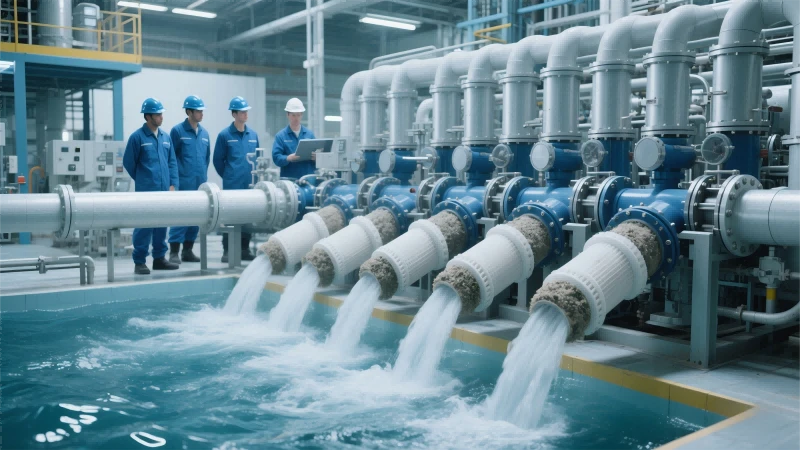
The primary challenge in desalination lies in the complex contaminants in raw water, including suspended particles, colloids, microorganisms (e.g., algae, bacteria), organic matter (e.g., TEP - Transparent Exopolymer Particles), and chemical residues. Inadequate removal of these contaminants causes rapid clogging of reverse osmosis (RO) membranes, significantly increasing energy consumption and membrane replacement frequency. As a critical pretreatment step, pre-filtration uses multi-stage filtration combinations (e.g., mechanical filtration, activated carbon adsorption, precision filter elements) to reduce influent turbidity to below 1 NTU and control SDI (Silt Density Index) within 3, providing long-term protection for RO membranes.
Hanzhikang's Perspective: Pre-filtration is not merely a "sieve" but a systematic engineering approach based on precise contaminant analysis. For example, targeting TEP colloids (seawater concentrations range from 3,000-40,000 particles/mL), Hanzhikang has developed gradient density filter elements. The microfiber winding technology achieves 2-micron-level filtration, effectively intercepting deformable colloids and overcoming the limitation of traditional sand filtration, which can only remove 30%.
Innovative Breakthroughs in Hanzhikang's Pre-filtration Technology
Hanzhikang's pre-filtration solutions integrate materials science and intelligent control, achieving all-around upgrades from filter element design to system integration:
High-precision Filter Element Technology
A composite structure combining PP wound filter elements and sintered stainless steel elements is adopted, with a porosity of over 80%, and the dirt-holding capacity is 3 times that of traditional elements. For instance, a 5-micron PP wound filter element can intercept 99.9% of suspended particles, while the gradient density design extends the backwashing cycle.
Intelligent Backwashing System
Integrated with pressure sensors and PLC controllers, it automatically starts the backwashing process based on real-time pressure difference, reducing water consumption by 75% compared to traditional sand filtration. For a 100,000-ton/day desalination project, this saves approximately 200,000 tons of backwashing water annually.
Modular Design
Standardized filter element interfaces support quick replacement and capacity expansion. For example, a single filtration unit can handle 500 m³/h flow, reducing floor space by 60% compared to traditional sand filtration and significantly lowering infrastructure costs.
CAPEX Reduction: From Equipment Selection to Life-cycle Costs
Hanzhikang achieves dual optimization of equipment investment and long-term operation through technological innovation:
Extended Membrane Replacement Cycle
The pre-filtration system extends the RO membrane lifespan from the traditional 3-5 years to 7-10 years. For a 10,000-ton/day desalination project, this saves approximately CNY 800,000 annually in membrane replacement costs.
Lower Energy and Infrastructure Costs
High-precision pre-filtration reduces RO system inlet pressure from 80-100 bar to 60-70 bar, decreasing energy consumption by over 20%. Meanwhile, the modular design reduces equipment footprint, saving 15%-20% in infrastructure investment.
Enhanced Material Durability
Sintered stainless steel filter elements use 316L material, with a seawater corrosion resistance lifespan exceeding 10 years. Compared to traditional carbon steel elements, this reduces replacement frequency and further lowers long-term costs.
OPEX Optimization: Energy Consumption, Maintenance, and Resource Efficiency
Hanzhikang's technology reduces operational costs from multiple dimensions:
Energy Management
The intelligent backwashing system activates only when necessary, reducing energy consumption by 50% compared to traditional sand filtration. For example, a 100,000-ton/day project can save approximately CNY 500,000 annually in electricity costs.
Maintenance Cost Control
The filter element replacement cycle extends from the traditional 3-6 months to 12-18 months, reducing maintenance man-hours by 70%. Additionally, the snap-fit design of filter elements allows single-person replacement, lowering labor costs.
Environmental Benefits
Reduced RO membrane replacements cut plastic waste by over 30 tons annually; backwash wastewater is recycled through a recovery system, increasing water resource utilization to 95%.
Case Analysis: How Pre-filtration is Reshaping Industry Standards
A Middle East Desalination Project
Challenge: Raw water turbidity reached 15 NTU, TEP content exceeded standards, and RO membranes needed replacement every 18 months.
Solution: Adopted Hanzhikang's multi-stage pre-filtration system (self-cleaning screen + gradient density filter elements + activated carbon adsorption).
Outcome: RO membrane lifespan extended to 8 years, energy consumption reduced by 22%, and annual O&M costs decreased by 40%.
Future Trends: Integration of Intelligence and Sustainability
Hanzhikang is driving pre-filtration technology toward intelligence and green development:
AI-driven Predictive Maintenance
Real-time monitoring of water quality and filter element status via IoT sensors, with AI algorithms predicting filter element lifespan and automatically triggering maintenance reminders to minimize downtime.
Renewable Energy Integration
Developing solar-powered self-cleaning systems, which can achieve 100% energy self-sufficiency in sunny regions, further reducing carbon footprint.
Biodegradable Filter Elements
Researching new bio-based filter element materials that can naturally decompose at the end of their lifespan, addressing environmental pollution from traditional elements.
FAQ
Q1: Is Hanzhikang's pre-filtration technology suitable for highly polluted seawater?
A1: Yes. Our gradient density filter elements combined with activated carbon adsorption effectively handle complex water quality with turbidity up to 50 NTU and excessive TEP content, validated in multiple coastal industrial projects.
Q2: What is the installation cycle for the pre-filtration system?
A2: The modular design supports rapid installation-commissioning of a single filtration unit is completed within 48 hours, shortening the overall project cycle by 30% compared to traditional sand filtration.
Q3: What is the cost of filter element replacement?
A3: Take a 5-micron PP wound filter element as an example, the cost per unit is approximately CNY 200, with a replacement cycle of 12-18 months, reducing annual maintenance costs by 50% compared to traditional elements.
Q4: How to address the impact of algal blooms on pre-filtration?
A4: Our self-cleaning screens intercept large-particle algae, complemented by sodium hypochlorite generators for biological inhibition, ensuring stable system operation.
Q5: Does Hanzhikang provide customized solutions?
A5: Yes. Our R&D team offers end-to-end customization-from filter element selection to system integration-based on raw water quality, water production requirements, and site conditions.
Conclusion
Hangzhou Hanzhikang Purification Equipment Co., Ltd. has redefined the cost and efficiency standards of desalination through advanced pre-filtration technology. Our solutions not only reduce CAPEX/OPEX but also provide a scalable path for global water resource crises through intelligent and sustainable innovations. Visit www.hzkfilter.com to learn how to make desalination more economical and environmentally friendly.