


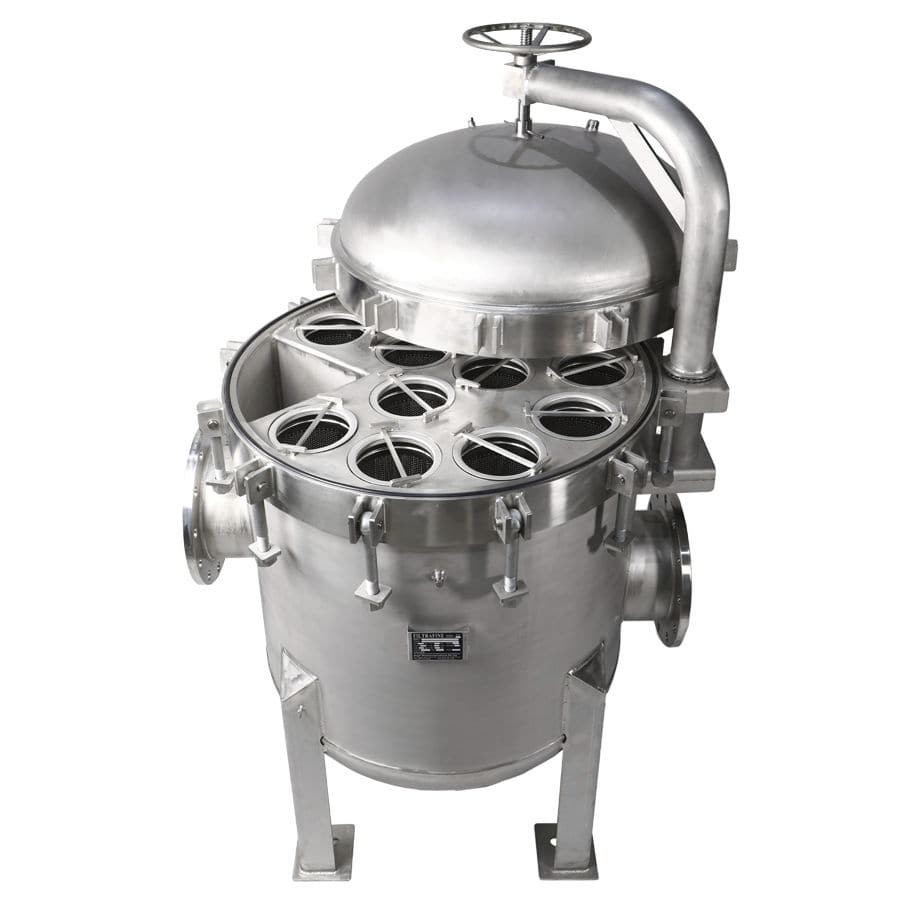
Filter housings are designed for heavy industrial applications requiring optimal performance to meet demanding process requirements.
– Liquid flows from the top through the inlet in the lid.
– Lid with hinged handle for easy changing of bags.
– The bag is aligned with the upper flange and held in place by compressing the gasket-equipped lid.
– Alignment of inlet and outlet simplifies filter installation and saves space.
– The filter includes a fixed basket for the bag.
– Made of 304 or 316L stainless steel, sandblasted or electropolished, suitable for flow rates from 20 to 50 m3/h.
Strong corrosion resistance: The filter shell made of stainless steel has excellent corrosion resistance and can operate stably for a long time in various harsh environments. It is suitable for the filtration needs of handling corrosive liquids.
Good pressure resistance: The stainless steel material has a strong structure and can withstand working conditions in high-pressure environments, ensuring safe and reliable operation of the filter housing and reducing maintenance and replacement costs.
Easy to clean and maintain: The stainless steel material has a smooth surface and is not easy to adhere to dirt. It is easy to clean and maintain, which can reduce downtime and improve production efficiency.
Strong flexibility: The stainless steel bag filter shell is suitable for various types and precision of filter bags. The appropriate filter media can be selected according to actual needs to meet the filtration requirements of different particulate matter.
Reliable filtration performance: The filter shell adopts a sealed design to effectively prevent leakage, ensure stable and reliable filtration effect, and ensure the quality and safety of the product during the production process.
Environmental protection and energy saving: The stainless steel material is recyclable and meets environmental protection requirements; at the same time, the excellent filtration performance can effectively improve production efficiency, reduce the waste of energy and materials, and achieve the purpose of energy saving and environmental protection.
To sum up, the stainless steel bag filter shell has many advantages such as corrosion resistance, pressure resistance, easy cleaning, flexibility, reliable filtration performance, environmental protection and energy saving, etc., and is an ideal choice in the field of industrial filtration.

| Technical Parameters | |
| Design pressure: | 0.96MPa 30min |
| Maximum working pressure: | 0.60MPa |
| Surface finish: | Ra≤0.2 |
| Design flow rate: | Ra≤0.2 |
| Interface form: | thread or flange |
| Type: | single bag or multi-bag filter |
FAQ:
1. What is bag filter housing?
Bag filter housing is a container used to hold bag filters in industrial filtration systems. It provides a sealed environment for the filtration process, allowing fluids to pass through while capturing particles in the filter bags.
2. What material are bag filters made of?
Bag filters can be made from various materials, including polyester, polypropylene, nylon, and other synthetic fibers. The choice of material depends on the specific application and the type of particles to be filtered.
3. What are filter housings made of?
Filter housings are commonly made from materials such as stainless steel, carbon steel, or plastic (such as polypropylene or PVC). These materials offer durability, corrosion resistance, and compatibility with different filtration processes.
4. How often should bag filters be changed?
The frequency of bag filter changes depends on factors like the type of particles being filtered, the volume of fluid processed, and the efficiency of the filtration system. Generally, bag filters are replaced when they reach their maximum capacity or when pressure differentials indicate clogging.
5. What are the disadvantages of bag filter?
Some disadvantages of bag filters include limited filtration efficiency for fine particles, potential for bypass leakage, and the need for regular maintenance and replacement, which can increase operating costs.
6. What are the disadvantages of bag house filter?
Baghouse filters may have disadvantages such as high initial investment costs, space requirements, and the potential for dust leakage during bag replacement or cleaning processes.
7. What material is best for a filter?
The best material for a filter depends on the specific application and the type of contaminants to be removed. Common filter materials include activated carbon, fiberglass, cellulose, and synthetic polymers like polyester or polypropylene.
8. What are the advantages of bag house filters?
Baghouse filters offer advantages such as high filtration efficiency, versatility for a wide range of applications, ease of maintenance, and the ability to handle large volumes of air or gas streams.
9. How many types of bag filters are there?
There are several types of bag filters, including pulse jet bag filters, reverse air bag filters, shaker bag filters, and cartridge bag filters. Each type has its own operating principle and suitability for different applications.
Hot Tags: bag filter housing stainless, China bag filter housing stainless manufacturers, suppliers, factory, heavy duty bag filter housing, plastic bag filter housing, compact bag filter housing, industrial bag filter housing, stainless steel bag filter housing, portable bag filter housing