

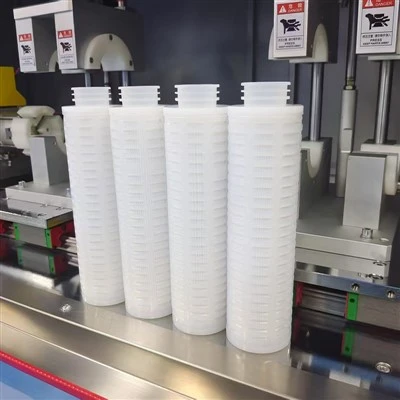
PFA Pleated Filter Cartridges are cartridge-style filtration elements that use a pleated membrane structure together with PFA components. The pleated configuration increases the available membrane area within a compact cartridge format, while the membrane acts as a physical barrier for particles and other contaminants present in the process fluid.
The concept is based on the same basic filtration principle used by other pleated cartridges: fluid passes through the porous filtration medium while particles larger than the effective pore size are retained. The difference is that the materials used for the cartridge structure and sealing system can be selected for more demanding chemical and process conditions.
Key point: A PFA cartridge should not be evaluated only by its filtration rating. The membrane, cage, core, end caps, support layers, sealing materials, process fluid, temperature, pressure, and required filtration performance should be considered as one filtration assembly.
How Do PFA Pleated Filter Cartridges Work?
1. Fluid Enters the Cartridge
The process fluid enters the filter housing and reaches the pleated filtration element. The cartridge is positioned so that the fluid is forced through the filtration medium rather than bypassing the filter.
2. Particles Are Retained
The porous membrane functions as a physical barrier. Particles at or above the effective filtration range are retained by the membrane while the filtered fluid continues through the cartridge.
3. Filtered Fluid Exits
After passing through the membrane and internal support structure, the filtered fluid moves toward the outlet of the housing. The cartridge therefore works as part of a complete filtration assembly rather than as an isolated component.
Pleating is important because it provides a larger filtration area than a flat membrane occupying the same basic cartridge footprint. The actual performance of a cartridge, however, depends on membrane properties, pore structure, fluid characteristics, pressure conditions, and the overall system configuration.
What Are the Main Components?
A PFA pleated filter cartridge consists of several components that work together to maintain filtration performance, structural support, and sealing. The exact configuration can vary according to the filtration system and process requirements.
Filtration Membrane
The membrane forms the primary filtration barrier. Its porous structure allows the process fluid to pass while retaining particles according to the filtration requirement.
PFA Cage
The cage supports the pleated membrane and helps maintain its shape during operation, particularly when the cartridge is exposed to differential pressure.
Core
The core provides internal structural support and helps maintain the cartridge geometry as fluid moves through the filtration media.
End Caps
End caps connect the filtration media and internal structure to the cartridge interface, helping form a complete and properly sealed assembly.
Gasket / O-Ring
The sealing element helps prevent fluid from bypassing the filtration media and must be selected according to the process fluid and operating conditions
Why Does Material Selection Matter?
Material selection is an important part of cartridge filtration because the filter element remains in direct contact with the process fluid. A membrane may provide the required particle retention, but the complete cartridge must also remain suitable for the chemical and operating conditions of the application.
For PFA Pleated Filter Cartridges, the PFA components can form part of the cartridge structure around the filtration membrane. The reference information for this cartridge type describes an expanded PTFE membrane combined with PFA cage, core, caps, and support components. This construction illustrates why membrane material and structural material should be evaluated together.
| Component / Factor | What to Evaluate | Why It Matters |
|---|---|---|
| Membrane | Material, pore structure, filtration range | Determines the primary separation function |
| PFA Components | Cage, core, caps, support | Contribute to structural integrity and material compatibility |
| Seals | O-ring or gasket material | Helps prevent fluid bypass around the cartridge |
| Housing Interface | Connection and installation configuration |
Affects installation and sealing performance |
What Should Buyers Consider When Selecting a Cartridge?
Selecting a filter cartridge should begin with the actual process requirements rather than with the cartridge name alone. The following factors should be reviewed before finalizing a filtration configuration.
Filtration Requirement
Define the required filtration range, target contaminants, particle characteristics, and required fluid cleanliness before selecting the cartridge.
Chemical Conditions
Consider the process fluid and its interaction with the membrane, PFA components, seals, housing, and other wetted parts.
Operating Conditions
Flow rate, operating pressure, temperature, operating cycle, and installation conditions should be evaluated as part of the complete system.
Cartridge Configuration
Cartridge dimensions, connection configuration, sealing arrangement, and housing compatibility need to match the filtration equipment.
Information to Prepare for Technical Evaluation
For filtration projects, Hanzhikang provides OEM and ODM support covering product design adjustments, manufacturing coordination, configuration optimization, and technical support. Filter-related configurations can be adjusted according to application conditions and filtration requirements, while project support can extend from product selection and customization to production coordination and delivery.
FAQ
Q1: What materials are used in a PFA cartridge assembly?
They use a porous pleated membrane as a physical barrier. Process fluid passes through the membrane while particles and contaminants within the retention range are captured.
Q2: What materials are used in a PFA cartridge assembly?
The reference construction includes an expanded PTFE membrane together with PFA cage, core, caps, and support components. The complete assembly may also include sealing components selected according to the application.
Q3: Can cartridge configurations be customized?
Filtration configurations can be evaluated and adjusted according to application conditions, filtration requirements, connection requirements, and project specifications.
Q4: What information should be provided when requesting a filtration solution?
Provide the required flow rate, operating pressure, process fluid, filtration requirements, installation conditions, and relevant cartridge or housing specifications. Drawings or existing product information can also help with technical evaluation.
Q5: Does Hanzhikang support OEM and ODM filtration projects?
Yes. Hanzhikang provides OEM and ODM customization support for filtration equipment and configurations, including product design adjustments, manufacturing support, and configuration optimization.
About Hangzhou Hanzhikang Purification Equipment Co., Ltd.
Hangzhou Hanzhikang Purification Equipment Co., Ltd. specializes in filtration equipment and components for industrial applications. Its product and engineering scope covers liquid filtration, gas filtration, bag filtration systems, stainless steel filters, and customized filtration solutions, including support related to PFA Pleated Filter Cartridges. With more than 15 years of industry experience and a production facility exceeding 10,000 m², Hanzhikang supports filtration projects through product selection, customization, manufacturing coordination, quality inspection coordination, packaging, and international shipment support.
Product Configuration Support
Hanzhikang can evaluate filtration structures, components, connection designs, and related configurations according to project requirements.
OEM & ODM Support
Customized filtration solutions can be developed through product design adjustments, manufacturing support, and configuration optimization.
Project Support
Technical support covers product selection, customization, production coordination, quality inspection coordination, packaging, and international shipment support.